Pune Scientists Explore a New Route to Break Down Polyurethane Plastic — A Potential Opportunity for Circular-Economy Startups !
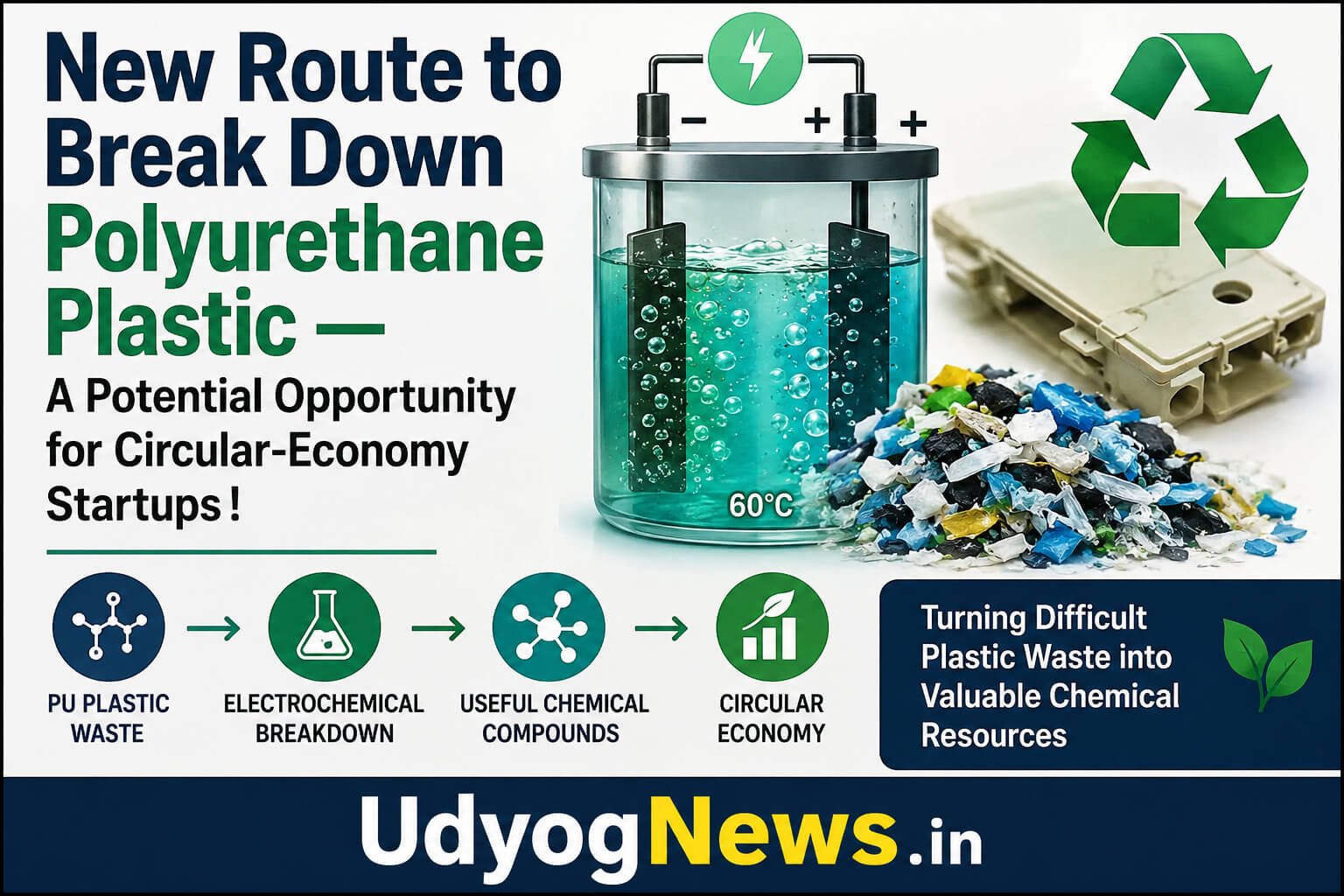
PUNE: A new research direction emerging from Pune could open an important pathway for the treatment and recycling of difficult-to-recycle polyurethane (PU) plastic waste, potentially creating a new industrial opportunity for Pune’s recycling and chemical-processing sector.
According to the report provided to UdyogNews.in, scientists associated with CSIR–National Chemical Laboratory (CSIR-NCL), Pune have explored an electrochemical method for breaking down polyurethane. The approach could be particularly relevant for industrial waste streams such as plastic pipes, casings and other PU-containing products.
The development is significant because conventional polyurethane waste treatment can be difficult. PU is used extensively in products including footwear, mattresses, furniture, automotive components, coatings and adhesives. CSIR-NCL and Covestro India have also been working together on chemical upcycling technologies for polyurethane waste, with the objective of converting difficult PU waste into useful chemical feedstocks.
Why Polyurethane Waste Is a Major Recycling Challenge
Plastic production continues to increase globally, but recycling remains difficult for several polymer types. Polyurethane is particularly challenging because its molecular structure can be highly stable and, depending on the formulation, cross-linked.
The newspaper report states that conventional methods for PU degradation may require temperatures above 150°C, high pressure and costly chemical inputs. The Pune research instead explores an electrochemical pathway that can operate at around 60°C, potentially reducing energy requirements.
The reported process uses controlled electrical current and electrodes to facilitate the breakdown of polyurethane. The research has reportedly examined the use of magnesium and platinum electrodes, together with chemical reactions occurring at the electrode surfaces.
Reported results
The report highlights several potentially important findings:
- Polyurethane degradation was achieved at approximately 60°C.
- The process reportedly achieved around 70–77% degradation in laboratory/experimental conditions.
- Useful chemical compounds containing C–N, C–O and C–N-related structures could be generated from the degraded material.
- The method was tested on difficult plastic products, including laptop and mobile-phone casings.
- Research reportedly achieved degradation of up to approximately 84% in some mobile-casing samples.
- Researchers also investigated whether polyurethane’s basic molecular structure could be modified, rather than simply destroying the material.
These figures should be treated as research-stage results, not as a guarantee of commercial plant performance. Chemical recycling of PU still faces challenges involving feedstock sorting, product purification, energy consumption, chemical recovery and scale-up.
The Bigger Opportunity for Pune’s Industrial Sector
For Pune, this research could have significance beyond environmental protection.
The Pimpri-Chinchwad, Bhosari, Chakan and Ranjangaon industrial belts generate large quantities of polymer-containing industrial scrap from automotive, electrical, electronics, engineering and consumer-product manufacturing.
A future commercial model could therefore be built around “PU Waste → Chemical Feedstock” rather than simply selling shredded plastic as low-value recycled material.
Potential Startup Idea: PU Chemical Recycling Hub
A Pune-based startup could develop a specialised Polyurethane Waste Collection + Pre-processing + Chemical Recycling facility.
Possible business model:
Industrial PU Waste
↓
Sorting & Identification
↓
Shredding / Pre-processing
↓
Electrochemical or Chemical Depolymerisation
↓
Separation & Purification
↓
Recovered Chemical Feedstocks
↓
Sale to Polymer / Chemical Manufacturers
This would potentially create a higher-value recycling business compared with conventional plastic shredding and granulation.
Advanced chemical recycling research is increasingly examining routes such as glycolysis, hydrolysis, acidolysis and other depolymerisation techniques to recover useful components from PU waste.
A New Business Opportunity: “PU Waste-as-a-Service”
An interesting Pune startup model could be to offer manufacturers a complete service:
“We collect your PU waste, scientifically process it and return recovered chemical value.”
The startup could target:
- Automotive component manufacturers
- Seat and foam manufacturers
- Furniture manufacturers
- Electrical/electronic manufacturers
- Plastic moulding companies
- Coating manufacturers
- Footwear manufacturers
- Mobile/electronic casing manufacturers
- Industrial scrap aggregators
Instead of manufacturers treating PU waste as a disposal liability, the waste could potentially become a recoverable resource.
Could This Become an Alternative to Conventional Plastic Recycling?
Not immediately.
The more accurate description is advanced chemical recycling or molecular recycling of polyurethane, rather than a complete replacement for conventional mechanical recycling.
Mechanical recycling remains useful where clean thermoplastics can be efficiently recovered. Chemical or electrochemical recycling becomes particularly interesting when the material is contaminated, mixed, cross-linked or difficult to recycle mechanically.
Recent research has demonstrated several approaches to breaking PU down into reusable chemical components, including pathways aimed at recovering polyols and, in some cases, isocyanate-related building blocks.
Why Pune Could Become a Testing Ground
Pune has a unique combination of:
Industrial waste + chemical research + automotive manufacturing + engineering talent + startup ecosystem.
The presence of CSIR-NCL in Pune makes the city particularly interesting for technology-led recycling ventures. The CSIR-NCL–Covestro collaboration itself demonstrates the potential for research institutions and industry to work together on PU waste upcycling.
A future startup could potentially build a pilot-scale PU recycling unit near Pune’s industrial clusters, subject to technology validation and all applicable environmental, hazardous-waste, chemical-storage and factory regulations.
UdyogNews Analysis: From Plastic Waste to Chemical Raw Material
The real significance of this development is not simply “plastic can be destroyed.”
The bigger question is:
Can difficult plastic waste be converted back into valuable chemical building blocks and re-enter the manufacturing cycle?
If electrochemical and other chemical-recycling technologies can be successfully scaled from laboratory experiments to economically viable industrial plants, Pune could potentially develop a new category of high-value plastic-waste processing businesses.
For entrepreneurs, this opens a possible opportunity at the intersection of environmental technology, chemical engineering, plastic recycling and circular manufacturing.
UdyogNews.in | Industrial Opportunity
PU Waste → Chemical Recovery → New Raw Material → Circular Manufacturing
Important: The electrochemical performance figures above are reported in the supplied newspaper material. They should be independently validated through the original scientific publication, pilot trials and techno-economic analysis before being presented as commercial process specifications.
SEO Keywords
Polyurethane recycling Pune, PU plastic recycling, plastic chemical recycling Maharashtra, CSIR NCL Pune, polyurethane waste management, electrochemical plastic recycling, plastic recycling startup Pune, chemical recycling technology India, PU waste recycling, Chakan MIDC plastic waste, Bhosari industrial waste, circular economy Pune, advanced plastic recycling, plastic upcycling India.